
At Long Last - A Serious Look at Food Insecurity
The cost-of-living crisis; food poverty (or just poverty?); inequality; social and economic deprivation; obesity and malnutrition; chronic public ill-health; ultra-processed convenience foods; food banks; BOGOF supermarket deals and food deserts. All the above and more could well be examples of the causes and effects of food insecurity currently being examined by Parliament's Right to Food UK Commission.
Earlier this year the commission came to Northumberland, arriving at Ashington's Hirst Welfare Centre on the 28th February as part of its national tour collecting evidence on food insecurity. Ian Byrne (MP for Liverpool West Derby) was instrumental in creating the Commission alongside the Right to Food Campaign, Westminster University, the Bakers and Allied Foodworkers Union and the Food and Work Campaign. Ultimately they hope to have written into law the right to adequate, accessible and nutritious food for all citizens.
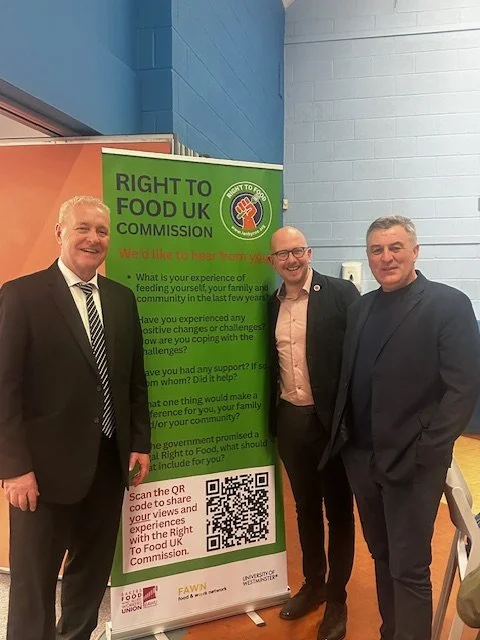
Right to Left, MPs Ian Byrne, Brian Leishman and Ian Lavery.
Local people who struggle to feed themselves and their families were invited to give their experiences as evidence while professionals and leaders in various relevant fields described what is being done to help.
Within small groups (each including a commissioner) people told their personal stories, described the support they thought they needed and suggested one initiative which could improve things generally. I heard how tough it can be when just-affordable bananas from one supermarket quickly 'go-off', while bananas from another outlet last much longer but are too expensive. I was told of the difficulty in feeding a family with three children who each have a different food allergy. I shared the frustration of those providing substantial roast school dinners as part of a healthier eating strategy only to find that surprisingly few children chose to eat them. The Commission Chair, part of our group, discussed with me whether Universal Basic Income could form part of a strategy to help make food more affordable.
Later Ian Bryne explained to me his interest in re-examining the post-war model of publicly-provided 'Peoples' Restaurants', of which there were 2000 in the UK and where people could buy affordable, healthy balanced meals. We also discussed ways to avoid the charity element in giving food-support, enabling greater autonomy and ensuring dignity within the process.
The scope of the Commission is far greater than my space to do justice to it here, so I urge you to look at a more comprehensive account at https://www.ianbyrne.org/rtfcommission
With food prices nearly 40% higher than in 2020 and 95% of families who report higher living costs saying it is due to food prices (Northumberland CC) the need for action could not be more urgent.
Paul Thompson